The permit is signed. The mitigation money is paid. And the community that showed up, submitted comments by the dozens, and asked Ohio EPA to do its job — got nothing.
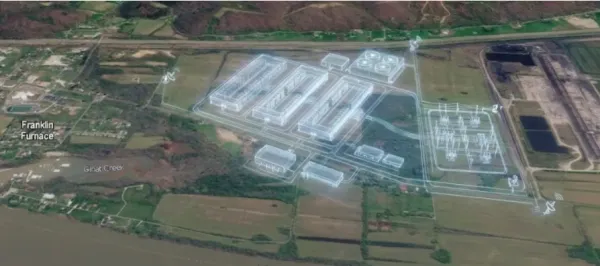
That is the documented outcome of Ohio EPA’s June 10, 2026, approval of Project Dazzler, a hyperscale data center campus proposed for Green Township, Scioto County, to be built by Tilted Gate LLC. The 792-acre property is located east of the Ohio River, south of Franklin Furnace. The site neighbors one of the region’s most toxic polluters, the Haverhill Coke Company.
What Ohio EPA actually approved
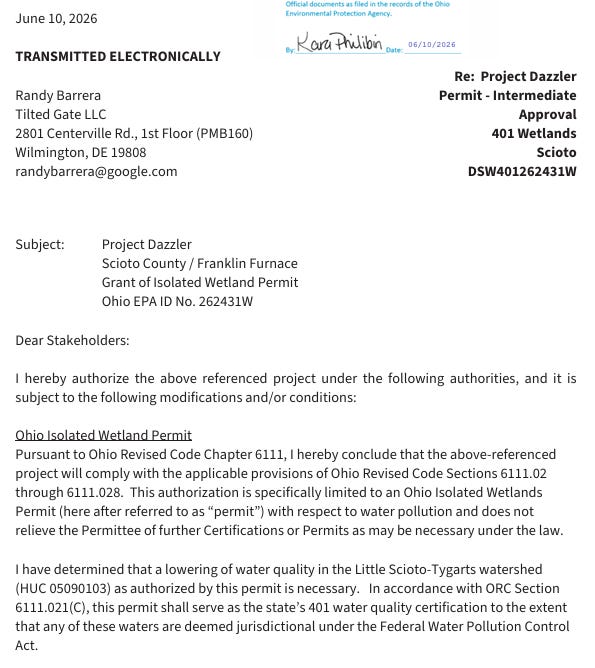
Ohio EPA Director John Logue issued Isolated Wetland Permit No. 262431W on June 10, 2026, authorizing the permanent destruction of 23.91 acres of wetlands in the Little Scioto-Tygarts watershed. The permit’s own language makes the regulatory concession explicit: Director Logue determined that “a lowering of water quality in the Little Scioto-Tygarts watershed (HUC 05090103) as authorized by this permit is necessary.”
Not unavoidable. Not regrettable. Necessary.
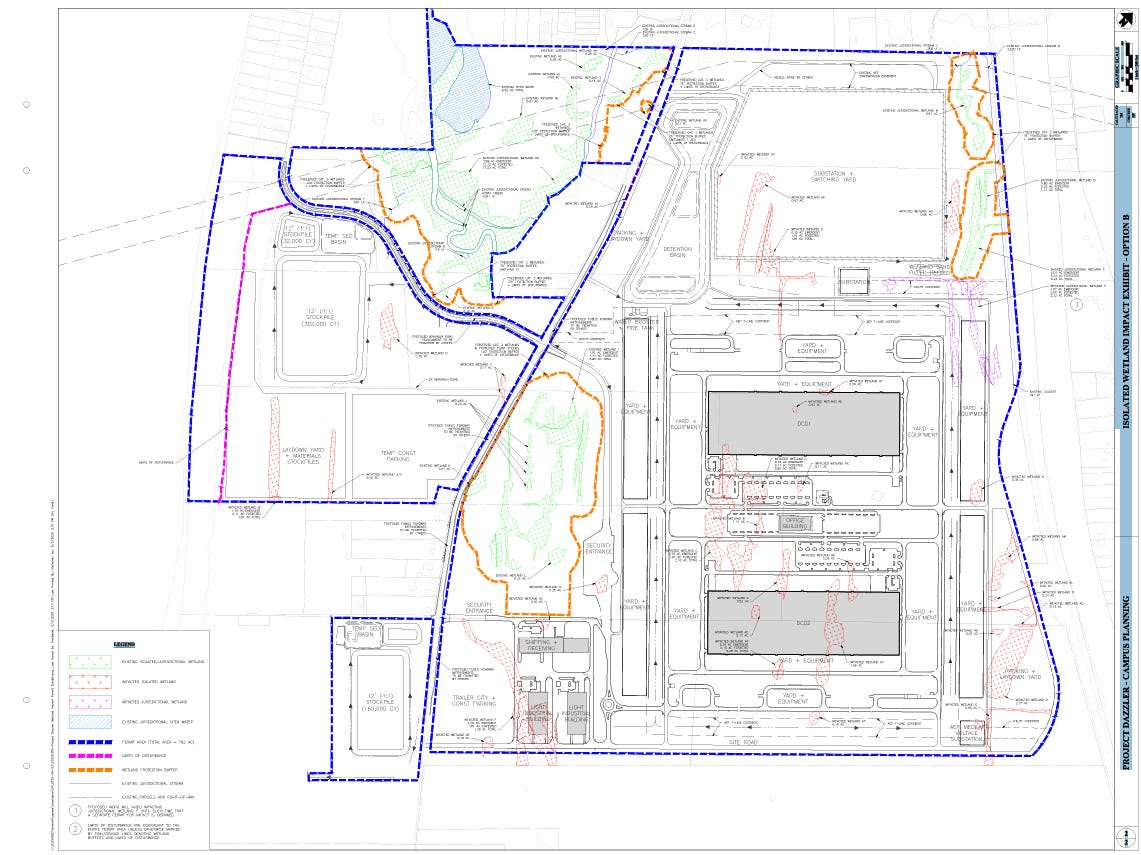
The 23.91 acres of authorized destruction breaks down as follows: 10.24 acres of emergent Category 1 wetlands, 0.27 acres of forested Category 1 wetlands, 5.46 acres of emergent Category 2 wetlands, and 7.94 acres of forested Category 2 wetlands — all permanently filled and graded to accommodate a minimum of 1.7 million square feet of data center building space, along with office buildings, equipment yards, an electrical substation, and associated infrastructure.
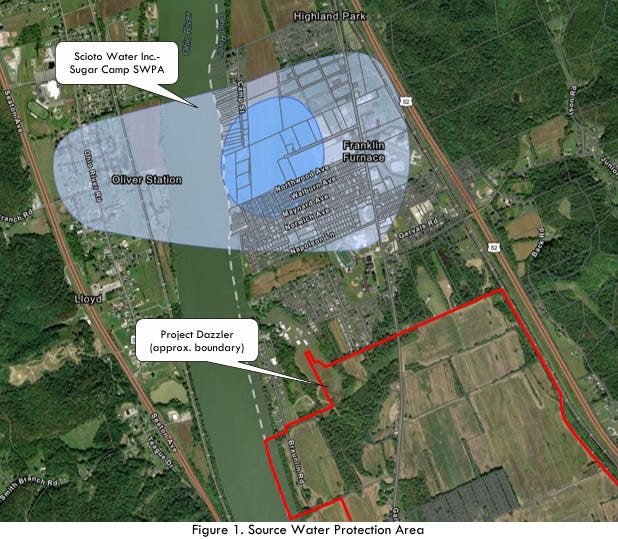
The affected watershed drains to two local creeks, both designated warmwater habitat streams and primary contact recreation waters. Both drain to the Ohio River. Ohio EPA’s own permit acknowledged the project may affect drinking water wells for the City of Portsmouth and flagged the proximity of the Scioto Water Inc. Sugar Camp source water protection area — located approximately 0.4 miles from the project boundary. The permit required Tilted Gate to notify Portsmouth water officials before construction begins. That condition is an implicit acknowledgment of risk to a public drinking water supply.
The permit also acknowledged that portions of the proposed development fall within the Ohio River 100-year floodplain. The applicant’s own flood hazard analysis concluded that post-construction grading would not increase the 100-year water surface elevation — a conclusion based entirely on the developer’s own consultant reports, which Ohio EPA accepted without independent verification.
The money changed hands the same day
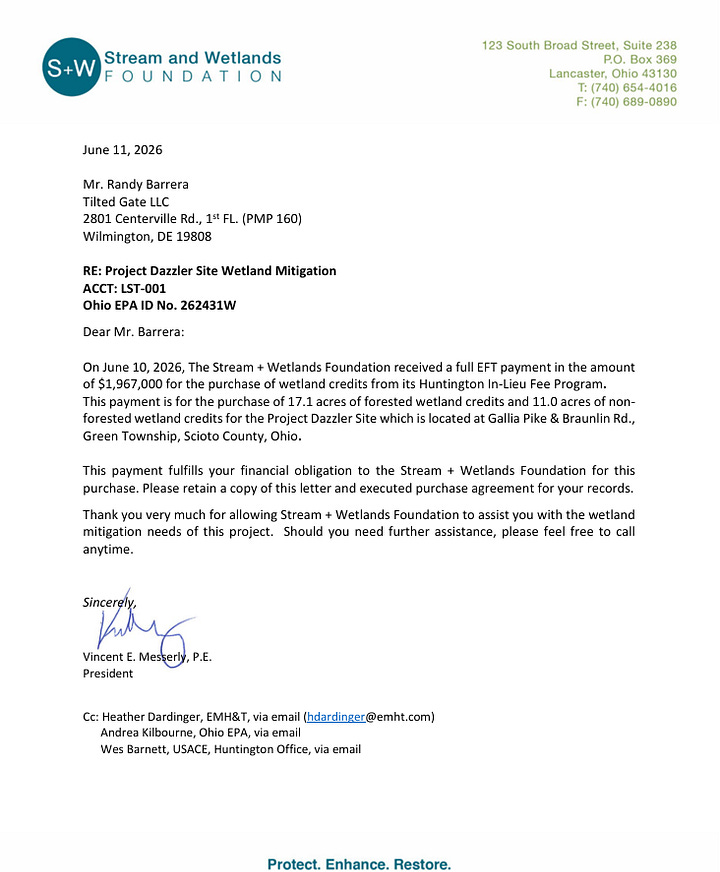
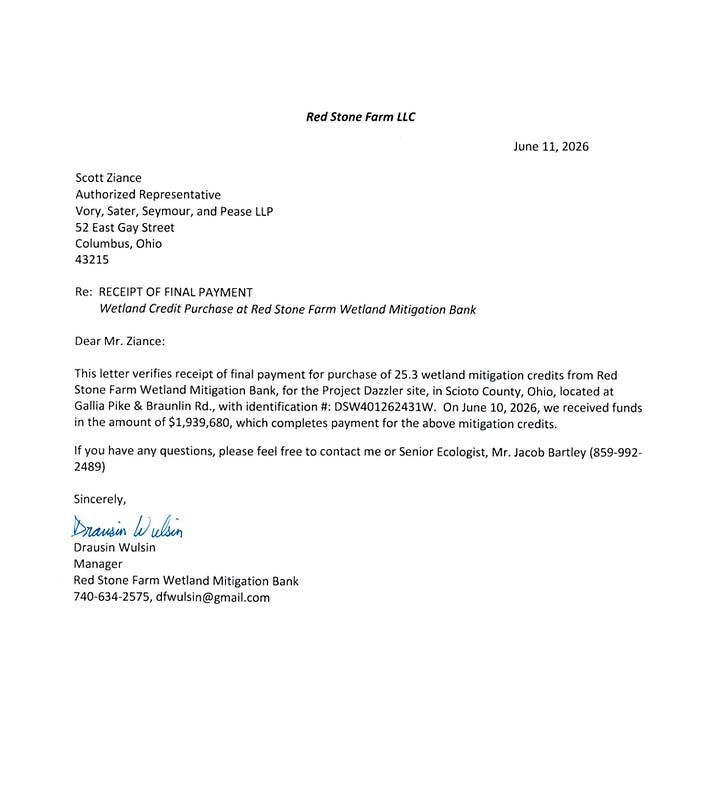
Two payment receipts dated June 11, 2026 — one day after permit issuance — confirm that mitigation payments were completed simultaneously with regulatory approval.
- Red Stone Farm Wetland Mitigation Bank, located in Pike County, confirmed receipt of final payment of $1,939,680 for the purchase of 25.3 wetland mitigation credits. The receipt states funds were received June 10, 2026 — the same date the permit was issued.
- Stream + Wetlands Foundation confirmed receipt of $1,967,000 via electronic funds transfer for 17.1 acres of forested wetland credits and 11.0 acres of non-forested wetland credits from its Huntington In-Lieu Fee Program. Those funds were also received June 10, 2026.
- Total mitigation payments: $3,906,680 — paid on the date of permit issuance.
Ohio EPA’s own permit required mitigation agreements to be executed within 30 days and stated wetland impacts could not begin until that condition was met. The payments were completed on the day the permit was signed. The regulatory and financial machinery moved in lockstep.
What “mitigation” means in practice: the 23.91 acres of functioning wetland in Scioto County will be permanently destroyed. Credits purchased from banks elsewhere in the watershed will be counted as replacements. The wetlands along Gallia Pike and Braunlin Road will not be restored. They will be gone.
The public said no. The record shows exactly how many times.
Ohio EPA held a public hearing on May 6, 2026, at Green Local Schools. The agency received comments from residents, adjacent property owners, environmental advocates, farmers, business owners, and legal professionals. The Guardian reviewed the complete comment file. What follows is what those documents say — in the words of the people who submitted them.
More than a third of all public comments requested outright denial of the permit. Ohio EPA’s response: the project meets legal requirements, so denial is not an option.
Multiple commenters requested a second public hearing. Ohio EPA declined, determining one hearing was sufficient.
An Ohio EPA representative, asked at the May 6 public hearing how many data center permit applications had ever been denied, answered: ZERO! That answer appears in the public comment record, submitted by a Franklin Furnace resident who wrote: “This tends to make me lose confidence in the EPA, which was formed to PROTECT our environment.”
A local resident, who identified herself as living within approximately two miles of the project site with an affected waterway running in front of her home, submitted a formal written comment stating: “Our community is already heavily burdened by multiple industrial and chemical facilities within a five-mile radius. We are not starting from a place of clean air or clean water.” She requested denial.
An adjacent property owner submitted a comment describing how the project was developed through closed-door arrangements before residents were informed: “The residents who live here have been kept in the dark until after deals were made. Then the county commissioners voted to give this fortune company a tax abatement.” She requested denial.
Two residents living on Braunlin Road in Franklin Furnace submitted detailed written concerns about stormwater routing, floodplain impacts, noise levels, light pollution, and the adequacy of the environmental review. They requested an extended comment period and an additional public hearing. Ohio EPA denied both requests.
A property owner on Raike Lane submitted a formal engineering analysis documenting that the lane is the only access point to their barns and garages, that portions of their property fall within mapped flood hazard zones, that three stockpile areas and a parking lot proposed by the developer are located below the Base Flood Elevation immediately adjacent to their property, and that the project raises unresolved questions about floodwater displacement onto neighboring land. Ohio EPA’s response to the flooding concerns: the developer’s own stormwater management report concluded post-development flow rates would not exceed pre-development rates.
A farmer in Franklin Furnace wrote: “I have spent years rebuilding riparian zones and natural wetlands on my property as well as cleaning up the area of my farm and around it. South East Ohio is a gem of forested hills and wetlands. We are in danger of losing this if we allow major development to ruin this.”
A lifelong resident wrote: “Everyone in our community have lost loved ones to cancer, even our children have been exposed as well. Saving what little wetlands and wildlife we have is the only hope for a brighter future.”
A resident in Franklin Furnace wrote: “We have deer, fox, coyotes, otters, bald eagles and some other rare birds, and of course the fish in the river. This is so disgusting and heartbreaking to think that a multi billion dollar company cares nothing about these things.”
One commenter raised concerns about potential impacts to Duduit Cemetery, located near Raike Lane. Ohio EPA responded that it has no authority over cultural and historic resources and referred the matter to the Army Corps of Engineers.
One commenter raised concerns about cumulative environmental impacts — the project layered on top of existing industrial facilities in an already-burdened community. Ohio EPA’s response: mitigation ratios are designed to maintain no net loss of wetlands. Cumulative community burden was not addressed.
One commenter formally alleged that the alternatives analysis was deficient because the applicant failed to follow the mitigation hierarchy required under Ohio Revised Code 6111.024. Ohio EPA’s response cited advantages of third-party mitigation banks without addressing the sequencing allegation directly.
Patrick McDavid, of 246 Junior Road in Ironton, submitted a detailed written comment — described as a supplement to testimony delivered at the May 6 hearing — raising five documented areas of concern: lack of public transparency, inadequate alternatives analysis, irreversible cumulative environmental impacts, inadequate protection for threatened and endangered species, and overstated economic benefit claims. On the economic projections, McDavid noted that permanent direct job estimates for the project had ranged from 50 employees to 500 or more depending on the source, and that the applicant’s claimed 9-to-1 job multiplier “is, by most standard RIMS II-style multipliers, considered very high” for a capital-intensive rural facility.
Ohio EPA’s economic justification for authorizing water quality degradation: the developer’s own antidegradation analysis projecting 200 permanent jobs and up to 500 temporary construction positions.
What was approved and what it means
Ohio EPA classified Project Dazzler as “socially and economically beneficial” — the legal threshold required under Ohio law to authorize the deliberate lowering of water quality in a high-quality watershed. That classification rests entirely on figures supplied by the applicant.
In exchange for that classification, Scioto County receives: 23.91 acres of permanently destroyed wetlands along the Ohio River corridor, authorized degradation of the Little Scioto-Tygarts watershed, a 1.7-million-square-foot industrial campus in rural Green Township, unresolved questions about impacts to Portsmouth’s drinking water supply, unresolved questions about floodplain impacts on adjacent residential properties, an questions about NDA’s sign by the county commissioners who approved the project, and a mitigation arrangement that will replace the destroyed wetlands with purchased credits at sites elsewhere in the watershed — credits that, as multiple commenters noted, have never been demonstrated to replicate the ecological function of the wetlands being destroyed.
The community showed up. They documented the risks in writing, on the record, for the agency whose name contains the word “protection.”
Ohio EPA reviewed their comments, responded to them, and issued the permit anyway.
The wetlands will be filled. The water quality will be lowered. And the question southern Ohio residents were never meaningfully given the opportunity to answer — whether any of this trade was theirs to make — was settled in Columbus on June 10, 2026.